
Tel : +86-20 3483 7127
Why does a twin-screw extruder need to be vacuumed?
Vacuuming in a twin-screw extruder offers numerous benefits, such as:
Removing Gases and Volatiles: During the extrusion process, the material may contain air, moisture, and other volatile components. If these gases and volatiles are not removed, they can form bubbles or voids in the final product, compromising its mechanical properties and appearance. Vacuum extraction effectively removes these gases and volatiles, ensuring the quality of the finished product.
Improved Material Mixing: Vacuum extraction helps achieve more uniform mixing of materials. In a vacuum environment, the viscosity of the materials decreases and their flowability increases, enabling more thorough mixing. This ensures even distribution among different components, enhancing the material’s homogeneity and quality.
Enhancing the mechanical properties of the product: By removing gases and volatiles from the material, we prevent the formation of bubbles and voids, thereby significantly improving the product’s mechanical properties, such as tensile strength and impact resistance.
Preventing oxidation and degradation: Some materials are prone to oxidation and thermal degradation at high temperatures, which can lead to a decline in performance. Vacuuming reduces the contact between the material and oxygen in the air, thereby lowering the risk of oxidation and degradation and helping to maintain the material’s stability and performance.
Enhanced Transparency: For certain transparent plastic materials, such as PET and PMMA, vacuuming can remove bubbles and impurities, significantly improving the product’s transparency and visual quality.
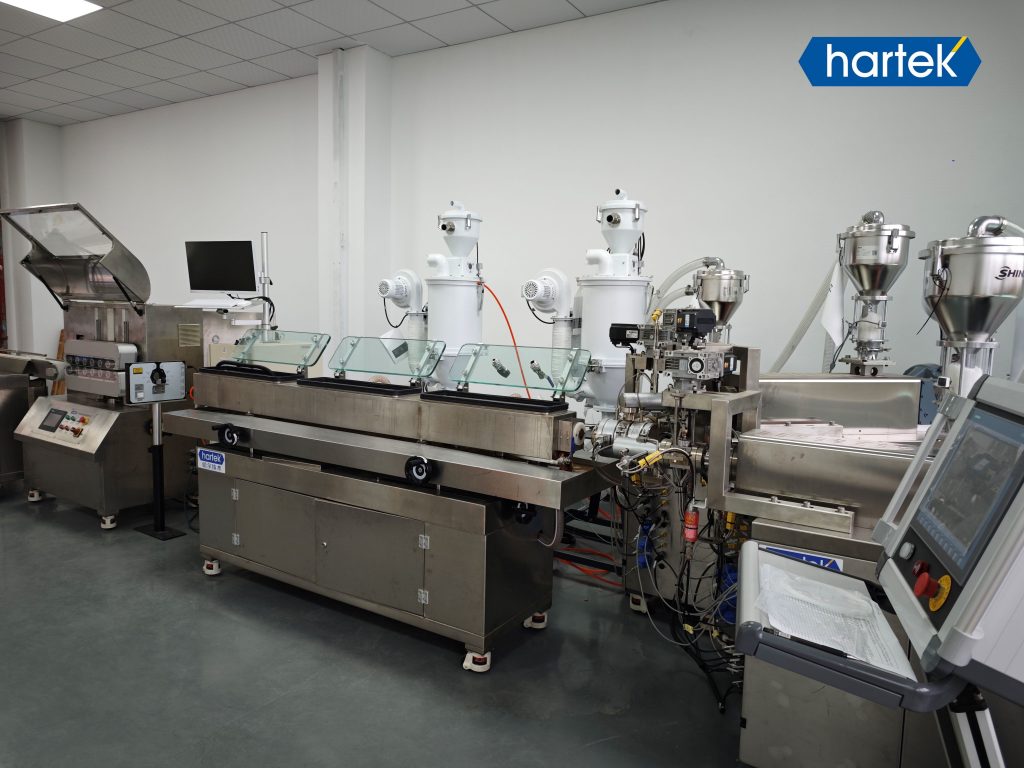
Hartek Technology Medical Three-Layer Co-extruded Pipe Production Pilot Line
In an experimental twin-screw extruder, where is the vacuum extraction located?
In an experimental twin-screw extruder, the vacuum extraction point is typically located in the middle to rear section of the screw; this section is referred to as the degassing zone. The following reasons justify selecting this particular location for vacuum extraction:
Selection of the degassing section:
Location: The vacuum port is positioned in the middle to rear section. At this location, the material has already undergone sufficient heating, plasticization, and preliminary mixing, achieving high fluidity and facilitating degassing.
Design: At this location, the screw design typically undergoes modifications—such as reducing the thread depth or employing special thread profiles—to create a larger free volume space, allowing gases to escape more easily from the material.
Vacuuming location and function:
Mid-section location: Setting a vacuum port in the middle section of the screw can effectively remove volatile substances and gases generated during the heating and mixing processes. At this stage, the material has lower viscosity, making it easier for gases to escape.
Rear section positioning: A vacuum port is installed in the rear section of the screw to further remove gases generated or left behind during the later stages of the extrusion process, thereby ensuring the quality and compactness of the final product.
Considerations during the operation:
Vacuum pump connection: The vacuum port is typically connected to a vacuum pump, which uses negative pressure to extract gases and volatiles from the material.
Sealing: To ensure the vacuum effect, the degassing section must have excellent sealing to prevent outside air from entering.
Operating parameters—such as vacuum level and pumping rate—need to be adjusted according to the specific material and process requirements in order to achieve the optimal degassing effect.
Guangzhou Hartek Technology Co., Ltd. is dedicated to the research and development and manufacturing of small-scale plastic processing and molding equipment for laboratory use, such as twin-screw extrusion granulation pilot lines, laboratory internal mixers, and film-blowing pilot lines. Our company provides customers with comprehensive technical consulting services, offers complete solutions, and develops customized laboratory construction plans.
Our company’s laboratory plastic machinery products are fully equipped with comprehensive functions, easy to operate, and highly scalable. They can be applied to a wide range of uses, including formulation development, process optimization, quality control, innovative research, design guidance, and training for technicians and students. These products are ideally suited for use in specialized institutions engaged in the research of polymer materials (plastics and rubber), in the product development or quality control departments of plastic processing enterprises, and in technical training programs at vocational schools.