
Tel : +86-20 3483 7127
In the experimental operation of a small two-roll mill, the speed ratio between the front and rear rolls, temperature settings, and roll gap are three critical process factors related to compounding quality. These parameters affect the intensity of shear action, dispersion uniformity, roll-covering behavior, and thermal history of the material, ultimately influencing the performance of the rubber compound or composite material.
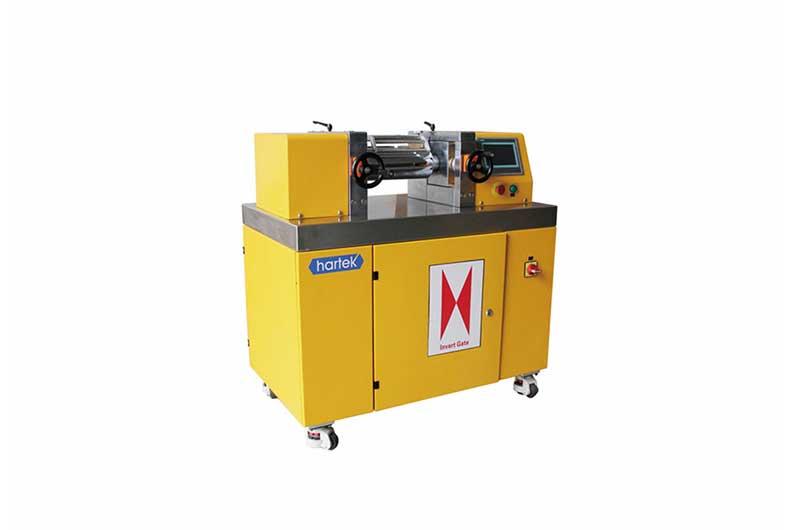
The front and rear rolls of a two-roll mill typically rotate at different speeds, creating a speed ratio. Common ratios include 1:1.1 and 1:1.2. The existence of a speed ratio creates a velocity gradient in the nip area, generating a shear flow field.
· If the speed ratio is too small (close to 1:1): The shear force is weak, making it difficult for the material to break up agglomerates, resulting in poor filler dispersion.
· If the speed ratio is too large (e.g., exceeding 1:1.4): The shear force is too strong, potentially causing localized overheating and degradation of heat-sensitive materials.
· Recommended settings: For natural rubber compounding, a speed ratio of 1:1.1 – 1:1.2 is often selected. For highly filled systems, it can be appropriately increased to 1:1.25 to enhance filler dispersion.
The speed ratio also affects the tendency of the material to adhere to the rolls (roll-covering). Generally, raw rubber is more likely to adhere to the slower roll. Therefore, the rear roll is often set as the slow roll to facilitate cutting and turning by the operator.
The front and rear rolls can be independently temperature-controlled. The temperature distribution strategy needs to be adjusted based on material characteristics.
· Isothermal setting (same temperature for both rolls): Suitable for materials with good thermal stability and a wide processing window, such as SBR.
· Front roll temperature higher than the rear roll: Helps maintain melt fluidity during sheeting, reducing surface roughness. This is often used in the processing of thermoplastic elastomers (TPE/TPU).
· Rear roll temperature higher than the front roll: Enhances the adhesion of raw rubber to the rear roll, facilitating powder incorporation. This is often used in the initial compounding stage of natural rubber or EPDM.
Generally, rubber compounding temperatures are controlled between 40–70°C, while thermoplastic materials (such as TPU) may require 80–120°C. Excessive temperature can easily lead to scorching or degradation of the material, while too low a temperature will make the material's fluidity poor and make powder incorporation difficult.
The roll gap refers to the minimum distance between the surfaces of the two rolls and directly determines the shear intensity and material residence time.
· Small roll gap (e.g., 0.5–1 mm): High shear force is beneficial for filler dispersion. However, the sheet produced is thin and prone to breaking, and the motor load is high.
· Large roll gap (e.g., 2–3 mm): Weak shear is suitable for plastication or preliminary mixing. The sheet produced is thick, facilitating subsequent operations.
· Typical process: Start with a large roll gap for powder incorporation and mixing, then gradually decrease the gap for refining, and finally adjust to the target thickness for sheeting.
The roll gap also affects the amount of "bank" (material accumulation above the nip). An appropriate amount of bank helps form a stable compounding zone, but too much can lead to poor heat dissipation or localized over-mixing.
The above three parameters need to be adjusted in coordination. For example:
· Compounding a high-filled calcium carbonate/PP system: Adopt a higher speed ratio (1:1.25), medium temperature (80°C), and decrease the roll gap in stages.
· Plasticating natural smoked sheet rubber: Use a low speed ratio (1:1.1), low temperature (50°C), and start with a large roll gap.
· Processing TPU: Set the front roll slightly higher than the rear roll (e.g., 90°C/80°C) with a speed ratio of 1:1.15 to avoid sticking.
Operators should dynamically optimize the combination of parameters by observing intuitive phenomena such as roll-covering status, bank morphology, and sheet surface finish, combined with torque or tactile feedback.
Reasonable settings for the speed ratio, temperature, and roll gap between the front and rear rolls are the foundation for maximizing the compounding efficiency of a small two-roll mill. Mastering the mechanisms of these variables helps improve experimental repeatability and the efficiency of material development.