Tel : +86-20 3483 7127
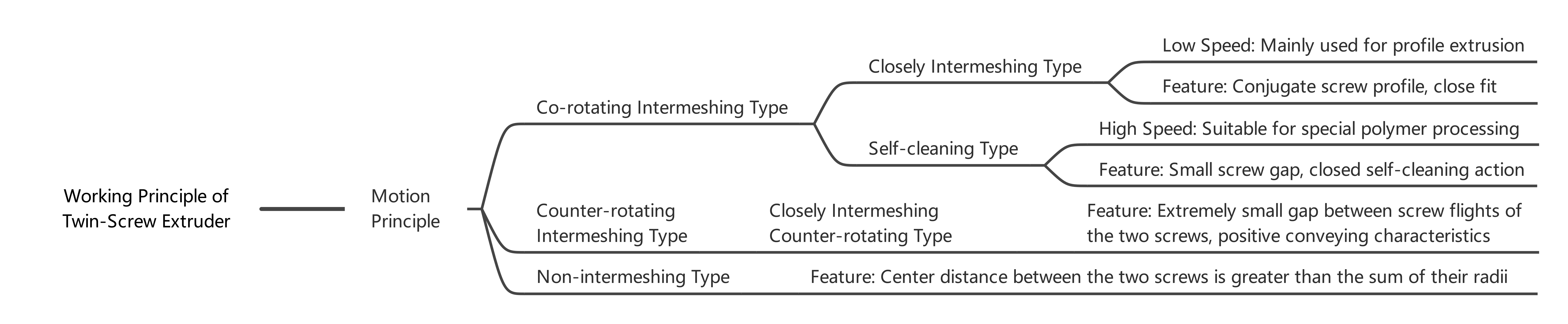
From the perspective of operating principles, co-rotating intermeshing, counter-rotating intermeshing, and non-intermeshing types in twin-screw extruders are distinct from one another.
These extruders come in two types—low-speed and high-speed—with the former primarily used for profile extrusion, while the latter is employed in specialized polymer processing operations.
(1) Tightly meshing extruder. Low-speed extruders feature a tightly meshing screw geometry, in which the thread profile of one screw is closely matched to that of the other, forming a conjugate screw profile.
(2) Self-cleaning extruder. High-speed co-rotating extruders feature closely matched screw flight profiles. The screw can be designed with a very small clearance, enabling the screw to achieve a sealed, self-cleaning action; such twin-screw extruders are referred to as tightly self-cleaning, co-rotating twin-screw extruders.
The clearance between the screw channels of the two screws in a tightly meshing counter-rotating twin-screw extruder is very small—much smaller than that in a co-rotating twin-screw extruder—thus enabling positive conveying characteristics.
In a non-meshing twin-screw extruder, the center distance between the two screws is greater than the sum of their radii.