
Tel : +86-20 3483 7127
In the competitive landscape of polymer research and development, the laboratory twin-screw extruder is not just a machine; it is the engine of innovation. While these machines are renowned for their versatility, their true potential is unlocked not by the hardware alone, but by the sophistication of their screw configuration.
At the heart of every high-performance extrusion process lies a meticulously engineered screw design. If you are looking to achieve superior material mixing, uniform melt flow, and rapid processing efficiency, understanding how to optimize your screw elements is the key to unlocking next-level results.
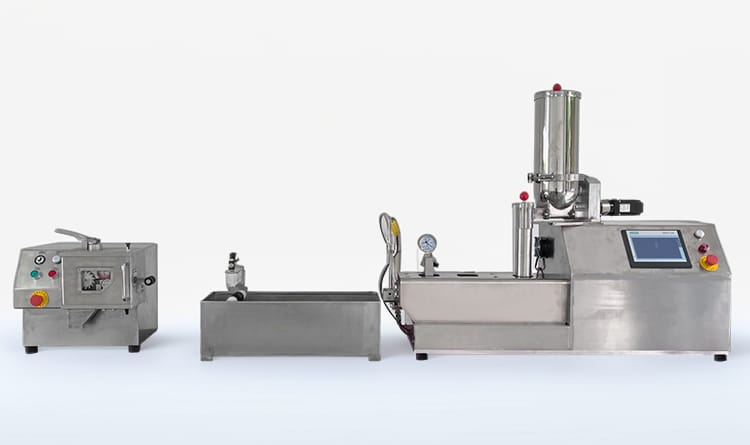
Here is how strategic screw design transforms your laboratory extruder from a standard tool into a high-precision instrument.
The journey to a perfect blend begins at the source. The feeding section dictates the initial stability of your process.
· The Challenge: Handling diverse materials, from low-bulk-density powders to fibrous compounds, without clogging.
· The Solution: Utilizing large-lead forward screw elements. This design maximizes the screw channel volume, ensuring smooth material intake.
· The Result: A significant 20%-30% improvement in conveying capacity, preventing jams and ensuring a consistent supply of raw materials to the barrel.
Once fed, solids must be transported and compacted efficiently to prepare for melting.
· The Strategy: A hybrid approach combining large-lead and small-lead forward threaded elements.
· The Benefit: This gradual transition compresses the material volume, increasing the filling density. For granular materials, this means faster melting and a more streamlined transition into the plasticizing phase.
This is the most critical phase, where mechanical energy is converted into thermal energy to create a homogeneous melt.
· The Innovation: A dynamic combination of meshing blocks, reverse-threaded elements, and asymmetric large-lead threads.
· The Performance: This configuration increases shear force to boost melting rates. Data shows this design can achieve a 40%-50% higher melting efficiency compared to traditional setups.
· The Safety Net: Reverse-threaded elements maintain optimal pressure, preventing excessive temperature spikes that could lead to thermal degradation of sensitive polymers.
For R&D, consistency is king. The mixing section ensures your additives and base polymers are perfectly dispersed.
· The Technology: Advanced turbine mixing elements and multi-head kneading blocks.
· The Outcome: A dramatic reduction in material particle size by 30%-40%. This level of dispersion is non-negotiable for achieving the high uniformity required in polymer blends.
Trapped moisture and volatiles are the enemies of product quality. An optimized venting section is essential for purity.
· The Mechanism: Large-lead threads paired with sealing elements create a thin melt layer, maximizing the free surface area for gas escape.
· The Guarantee: This design effectively reduces moisture and volatile content by 10%-20%, virtually eliminating the risk of bubble formation in your final product.
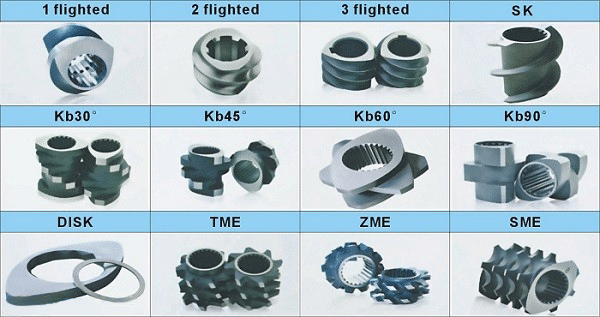
To visualize the impact of a well-designed screw configuration, consider the following comparative advantages:
|
Feature |
Standard Design |
Optimized Design |
Impact |
|
Melting Efficiency |
Standard |
+40% to 50% |
Faster processing cycles |
|
Particle Size (Mixing) |
Variable |
-30% to 40% |
Superior blend uniformity |
|
Moisture/Volatiles |
Higher Risk |
-10% to 20% |
Higher product purity |
An optimized screw configuration is not merely a mechanical adjustment; it is a strategic investment in your R&D output. By reducing melting time by over 40% and significantly boosting conveying capacity, you are not just running experiments—you are accelerating time-to-market.
Don't let suboptimal design limit your potential. By tailoring your screw elements to your specific material needs, you ensure efficient, stable processing and unlock the full capability of your laboratory twin-screw extruder.