
Tel : +86-20 3483 7127
In the R&D of cast films using novel engineering plastics, material stability during high-temperature extrusion remains the core challenge. These materials typically require processing at high temperatures ranging from 250°C to 400°C, making them prone to molecular chain degradation and fluctuations in melt properties. Such issues often lead to the scrapping of films due to discoloration, embrittlement, and excessive thickness deviations.
Starting from the root causes of high-temperature material failure and drawing on hands-on laboratory R&D experience, this article proposes three key adaptation strategies: screw configuration selection, precise temperature control, and synergistic optimization of process parameters. These insights aim to provide technical references for minimizing R&D losses.
1. Core Causes of Poor High-Temperature Stability in Novel Engineering Plastics
The molecular structure and processing characteristics of novel engineering plastics inherently make them susceptible to stability issues under high-temperature conditions. This is primarily attributed to the following three factors:
A. Thermal Degradation Characteristics of Molecular Chains
Most engineering plastics contain rigid structures such as aromatic rings and ether bonds in their molecular chains. While these structures endow the materials with excellent high-temperature resistance, prolonged exposure to high temperatures can easily trigger chain scission or crosslinking reactions. For example, when PEEK is processed above 380°C with a residence time exceeding 5 minutes, the rate of molecular chain scission increases by 10%–15%. This leads to a 20%–30% drop in melt viscosity, ultimately reducing the tensile strength of the cast film by 15%–20% and causing surface yellowing and discoloration.
B. Sensitive Fluctuations in Melt Flowability
The melt flow rate (MFR) of engineering plastics is highly sensitive to temperature variations. A temperature fluctuation of merely ±5°C can cause an MFR deviation of 10%–15%. In laboratory cast film extruders with small processing capacities, the melt has a short residence time in the barrel. Even minor temperature fluctuations can cause uneven melt flowability, leading to die exit velocity fluctuations exceeding 8%. Consequently, the thickness deviation of the film expands from ±2% to ±5%, accompanied by wavy edge defects.
C. High-Temperature Failure of Additives
To improve the processing performance of engineering plastics, additives such as antioxidants and lubricants are commonly incorporated. However, these additives are prone to volatilization or decomposition at high temperatures. For instance, phosphate antioxidants frequently used in PC processing gradually volatilize above 300°C, reducing the material's resistance to degradation and easily causing "crazing" during processing. Meanwhile, the failure of lubricants increases the frictional resistance between the melt and the barrel or die, resulting in poor material discharge and surface scratches on the film.
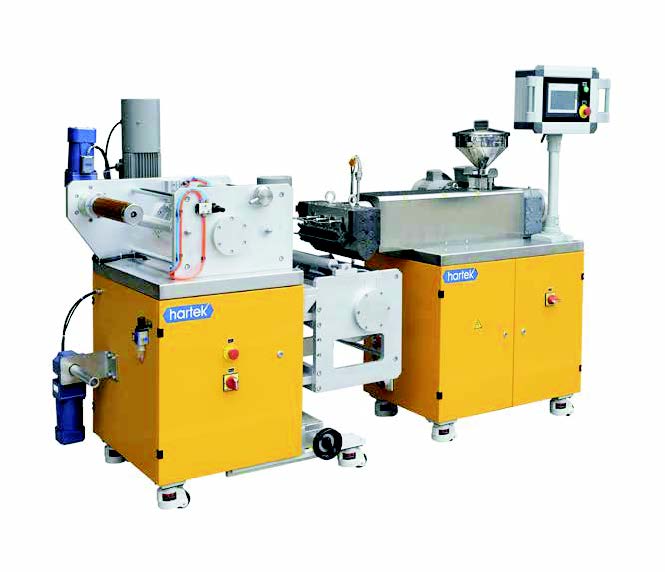
2. Adaptation Strategy 1: Precise Selection of Screw Configuration
The screw configuration directly impacts the plasticizing efficiency, mixing uniformity, and residence time of the material. Therefore, it must be customized according to the melting characteristics and thermal stability requirements of the specific engineering plastic:
A. Selecting Screw Structure Based on Material Melting Characteristics
For low melt viscosity materials: A screw with a "gradually varying channel depth" is recommended. The channel depth gradually decreases from the feed zone to the metering zone to reduce shear intensity, preventing molecular chain degradation caused by excessive shearing. Additionally, 2-3 sets of mixing elements should be incorporated to ensure uniform melt mixing and minimize localized overheating.
For high melt viscosity materials: A screw with a "suddenly varying channel depth" is required. The channel depth should decrease rapidly in the compression zone to enhance shear and plasticizing capability. Meanwhile, the length of the metering zone should be increased to extend the melt homogenization time, avoiding internal stress concentration in the film caused by uneven plasticization.
B. Controlling Screw Length-to-Diameter Ratio and Residence Time
The length-to-diameter (L/D) ratio of the screw in a laboratory cast film extruder should be controlled between 20 and 25. An excessively small L/D ratio can lead to insufficient plasticization, while an overly large ratio will prolong the residence time of the melt in the barrel, increasing the risk of thermal degradation. For instance, when developing PEEK cast films, using a screw with an L/D ratio of 22, combined with a screw speed of 50–60 r/min, can keep the melt residence time within 4–6 minutes, reducing the molecular chain degradation rate to below 5%.
3. Adaptation Strategy 2: Strict Control of Temperature Precision
Temperature control is the key to preventing high-temperature degradation of engineering plastics. A precision control system must be established focusing on three aspects: "segmented temperature control, deviation calibration, and real-time monitoring."
The barrel should be divided into 3 to 5 independent temperature control zones, with gradient temperatures set according to material characteristics. Taking the R&D of PI cast films as an example, the recommended temperature settings are: 300–320°C for the feed zone, 340–350°C for the compression zone, 360–370°C for the metering zone, and 370–380°C for the die head. The temperature deviation in each zone must be controlled within ±1°C to prevent material degradation caused by localized overheating.
B. Regular Calibration of Temperature Sensing Elements
Components such as thermocouples and heating bands in laboratory cast film extruders are prone to accuracy deviations due to prolonged exposure to high temperatures. Monthly calibration is required: use a standard thermometer to measure the actual temperature of each barrel section. If the deviation from the set value exceeds ±1.5°C, the thermocouple must be replaced or the heating power adjusted. Special attention should be paid to calibrating the die head temperature to avoid uneven film thickness caused by fluctuations in the die exit temperature.
C. Implementing Real-Time Melt Temperature Monitoring
Install a melt temperature sensor at the die exit to monitor melt temperature changes in real time. When the temperature fluctuation exceeds ±2°C, an automatic warning is triggered to allow for timely adjustment of heating power. Experimental data shows that adding melt temperature monitoring can reduce the scrap rate due to film discoloration by 40%–50% and keep thickness deviation within ±2.5%.
4. Adaptation Strategy 3: Synergistic Optimization of Process Parameters
Process parameters such as screw speed, extrusion pressure, and cooling rate must be matched synergistically to avoid imbalances in melt properties caused by adjusting a single parameter in isolation.
A. Matching Screw Speed with Extrusion Pressure
Screw speed directly affects extrusion pressure and melt residence time, and must be adjusted according to the melt viscosity of the material. For high-viscosity materials, a speed of 40–50 r/min is recommended, with extrusion pressure controlled between 15–20 MPa to prevent shear heating caused by excessive pressure. For low-viscosity materials, the speed can be increased to 60–70 r/min, with extrusion pressure maintained at 8–12 MPa to reduce the residence time of the melt in the barrel. The screw speed should be adjusted in increments of no more than 5 r/min at a time to avoid output fluctuations caused by sudden pressure changes.
B. Adapting Cooling Rate to Melt Temperature
The cooling rate of engineering plastic cast films must be coordinated with the melt temperature to avoid internal stress concentration caused by rapid cooling. Materials processed at high temperatures require "gradient cooling": the temperature of the first cooling roll section should be set to 120–150°C, the second section reduced to 80–100°C, and the third section to 40–60°C. This gradual temperature reduction minimizes warpage and deformation. For materials processed at medium temperatures, "rapid cooling" can be adopted by setting the cooling roll temperature to 60–80°C, which shortens the cooling time and prevents reduced toughness caused by excessive crystallinity.
C. Aligning Raw Material Pre-treatment with Processing
Strict pre-treatment of raw materials is required before processing. Engineering plastic pellets must be dried at 120–150°C for 4–6 hours to ensure a moisture content of ≤0.02%, preventing film bubbles caused by moisture vaporization at high temperatures. For modified engineering plastics, a dedicated feed hopper should be used to avoid uneven melt mixing due to fiber agglomeration. Additionally, the screw speed should be appropriately increased to enhance dispersion.
5. Conclusion
To address the high-temperature stability issues of novel engineering plastic cast films, solutions must be grounded in material characteristics, focusing on three core adaptation strategies: precise selection of screw configuration, strict control of temperature accuracy, and synergistic optimization of process parameters. In laboratory R&D, adaptation plans should be dynamically adjusted based on the specific processing characteristics of each material to minimize material waste caused by molecular chain degradation and melt fluctuations. Future efforts should further explore an intelligent linkage system integrating "screw configuration, temperature control, and process parameters," utilizing real-time data feedback for automatic parameter adjustment to enhance both R&D efficiency and product stability.
PREVIOUS :
none
NEXT :
The rotation speed of the twin-screw is not the faster, the better