
Tel : +86-20 3483 7127
Roller temperature is a key variable for controlling the viscoelastic properties and chemical reaction rates of the rubber compound.
Key control points: Low temperatures can cause the rubber compound to become harder and make it difficult to feed into the mill; high temperatures, on the other hand, may lead to sticking to the rollers or scorching. It is necessary to set a temperature difference between the front and rear rolls to ensure stable coating of the rubber compound.
Operating recommendation: Set the temperature range according to the type of elastomer. For example, when using the HTR-120 open mill with Hartek, its temperature control accuracy of ±2℃ can effectively prevent local overheating and ensure uniform temperature distribution throughout the milling zone.
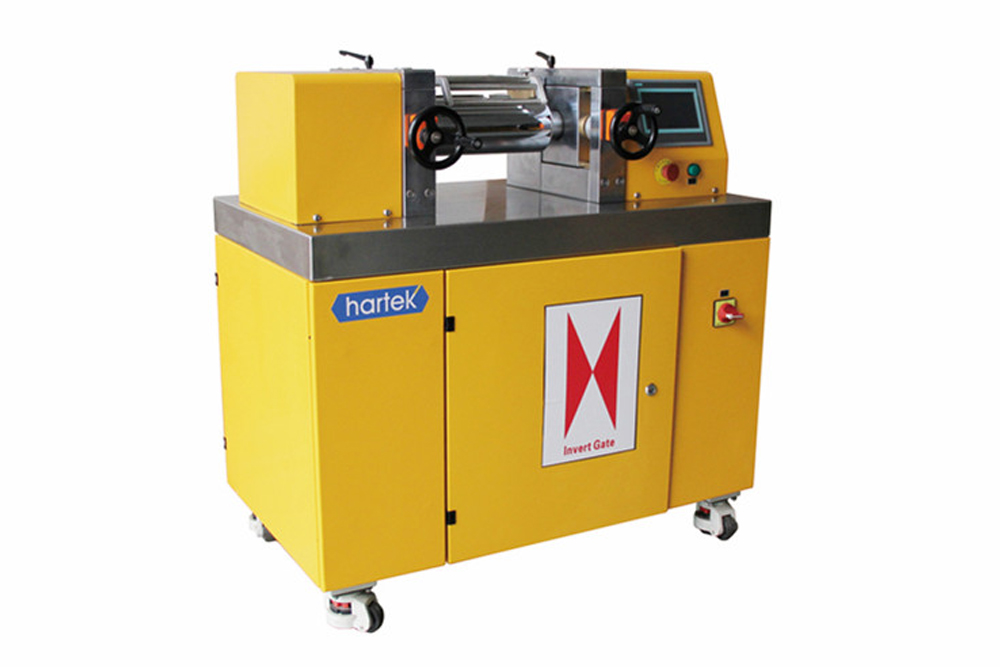
Hartek Lab Twin-Roll Open Mill
The roll gap determines the shear strength and distribution characteristics.
The duration of mixing and the operational techniques together determine the total amount and uniformity of energy input.
Key control points: Insufficient mixing time can lead to uneven dispersion; excessively long mixing time may cause molecular chain degradation or scorching.
Operating recommendation: Follow the standard feeding sequence: raw rubber → activator/antioxidant → filler → plasticizer → vulcanizing agent. Ensure overall uniformity by monitoring the appearance and feel of the compound and adhering to operational guidelines.
Phenomenon: The rubber compound surface is rough, and undispersed powder particles can be seen inside.
Phenomenon: The rubber compound prematurely vulcanizes during mixing or storage, losing its fluidity and reworkability.
Cause: The roller temperature is too high; the mixing time is excessively long, especially after the vulcanizing agent has been added; the timing of adding the vulcanization system is inappropriate.
Countermeasure: Immediately reduce the roll temperature; strictly control the addition of vulcanizing agents during the low-temperature stage (e.g., when the rubber compound temperature drops below 100℃) and ensure rapid mixing and sheeting; re-examine the formulation for scorch safety.
Phenomenon: The rubber compound excessively adheres to the rollers or fails to stabilize around them.
Cause: Adhesion to the rollers is often due to excessively high temperature, overly soft rubber compound, or excessive plasticizer in the formulation; detachment from the rollers is typically caused by too low a temperature, an overly hard rubber compound, or an unreasonable temperature difference between the front and rear rollers.
Countermeasures: When sticking occurs, try lowering the roll temperature or adjusting the formulation; when peeling off the rolls, appropriately raise the roll temperature—especially the temperature of the back roll—to help prevent the material from sticking to the rolls.
Phenomenon: A frost-like powder precipitates on the surface of compounded rubber or vulcanized rubber.
Phenomenon: Bubbles or uneven color and texture are present inside the film.
Cause: The roll gap was too large during the rolling process, causing air to be entrained; the refining operation was not performed according to standard procedures; the raw materials contained moisture.
Countermeasures: During the next stage, appropriately reduce the roll gap to ensure thorough venting; adopt standardized rolling and refining procedures; and make sure all raw materials are thoroughly dried.
The operational efficiency of a laboratory two-roll open mill depends on the precise control of key parameters such as roll temperature, roll gap, and mixing sequence, as well as the ability to respond swiftly to common defects. Selecting a device with reliable performance is an essential guarantee for achieving these goals. For example, the HTR-120 open mill from Hartek features an effective roll surface width of 300 mm, a sheet thickness adjustment range of 0.2–2 mm, and a temperature-control system, providing a dependable process-control window for laboratory mixing. By implementing systematic parameter management and effective problem-solving strategies, experimental efficiency and data reliability can be significantly enhanced.