
Tel : +86-20 3483 7127
The benchtop internal mixer is a miniature experimental device designed to meet the demand for closed-mixing of polymer materials. It is suitable for formulation optimization and process validation of rubber, PVC, elastomers, engineering plastics, and composite materials. Its core function lies in achieving efficient and uniform mixing of raw rubber with various additives by leveraging mechanical shear forces within a sealed chamber, combined with heat conduction effects inside the chamber.
Compared to open-mill rubber mixers or twin-screw extruders, this equipment features a fully enclosed mixing structure, offering advantages such as minimal dust pollution, high thermal energy utilization, and excellent repeatability of experimental data. It is particularly well-suited for R&D applications that require precise control over dispersion, scorch characteristics, or rheological behavior.
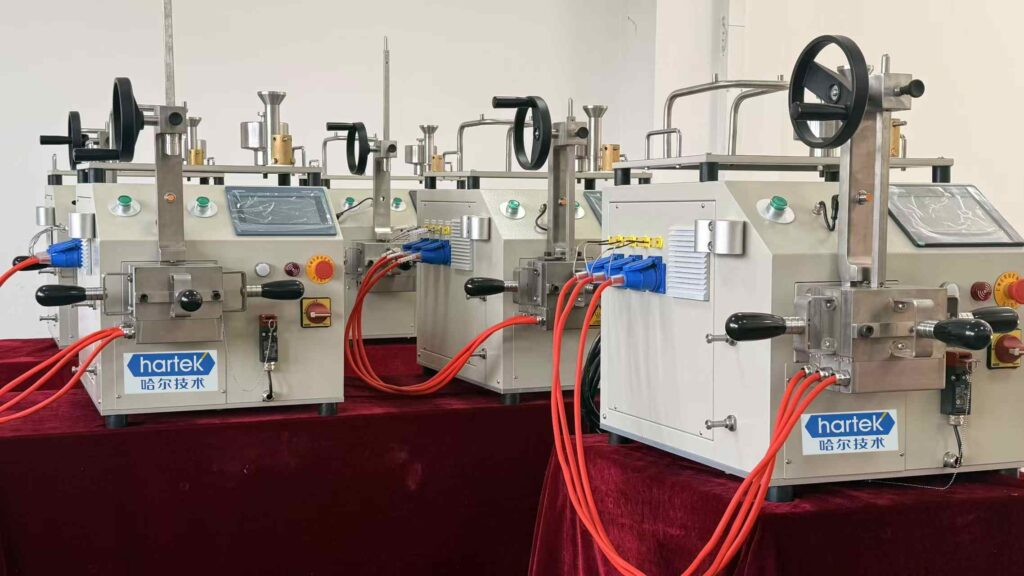
Lab Banbury Mixer
I. Core Structural Analysis
A typical benchtop internal mixer consists of the following modules:
Mixing chamber
Effective volume range: 50 mL to 1 L. Made from hardened steel or special stainless steel, with the inner wall undergoing special hardening treatment to enhance wear resistance.
Rotor system
A pair of counter-rotating rotors is configured; common geometric shapes include elliptical (Banbury type), intermeshing, and pin-type. Different configurations directly affect shear strength and dispersion efficiency.
Temperature control module
Temperature control is achieved via electric heating or a thermally conductive oil/water circulation system, with temperature control accuracy reaching ±1-2℃. The operating range covers temperatures from room temperature up to 300℃.
The feeding mechanism consists of a feeding hopper and a pneumatic/manual pressing device. After feeding is complete, the pressurizing plunger seals the system to create a positive-pressure mixing environment.
Power Transmission and Monitoring System
The servo motor drives the rotor to rotate, and an integrated torque sensor collects real-time mixing power data, generating a dynamic torque-time curve.
Intelligent control system
Supports preset parameters such as rotational speed, temperature, and mixing duration, and simultaneously displays real-time process parameters like torque and temperature.
II. Process Flow Description
The equipment operation consists of four stages:
Charging stage
Place the raw rubber into the mixing chamber, seal the pressurizing plunger after starting it up, and then add various compounding agents in batches according to the preset sequence.
Imbibition Mixing Stage
The high-speed rotation of the rotor generates a strong shear force field, promoting the initial wetting of the polymer matrix by the additive, and causing the torque value to rise rapidly.
Fine dispersion stage
Under continuous shear and compression, the filler aggregates disaggregate, achieving uniform dispersion at the microscale, and the torque curve stabilizes.
Material layout stage
After the set process conditions are met, open the bottom discharge port to discharge the compounded rubber material, thus completing a single compounding cycle.
The typical mixing cycle lasts from 3 to 15 minutes, with the specific duration depending on the material system and process objectives. The torque-time curve serves as a key quality indicator, intuitively reflecting the material’s powder-uptake rate, dispersion quality, and early-stage vulcanization tendency.
III. Key Technical Indicators
|
Parameter |
Typical range |
|
Mixing Chamber Volume |
50 mL – 1000 mL |
|
Rotor Speed |
20 – 200 rpm (Adjustable) |
|
Temperature Control Range |
Room Temp – 300℃ (±1–2℃) |
|
Speed Ratio (Front/Rear Rotors) |
1:1 (Synchronous) or 1:1.1–1:1.25 (Asynchronous) |
|
Torque Measurement |
Real-time display, Unit: N·m |
IV. Typical Application Scenarios
Rubber formulation development
Optimize mixing processes and perform preliminary assessments of vulcanization characteristics for systems including natural rubber (NR), styrene-butadiene rubber (SBR), and ethylene propylene diene monomer rubber (EPDM).
Elastomer Modification Research
Evaluate the dispersion of fillers/plasticizers and processing performance in materials such as TPE, TPU, and TPV.
High-filler system development
Test the mixing uniformity of systems such as silicone + white carbon black and rubber + high-ratio calcium carbonate.
Research on Recycled Materials
Evaluate the feasibility of recompounding waste rubber/plastic and the extent to which its properties can be restored.
Teaching and Basic Research
For the polymer materials processing course, demonstrating the fundamental principles of compounding kinetics and rheology.
V. Key Points of Operational Standards
1. Strictly follow the order of material addition to prevent premature contact between accelerators and vulcanizing agents, which could cause scorching.
2. The cavity must be preheated to the target temperature before mixing.
3. Immediately clean the rotor and cavity walls after discharging to prevent residual materials from carbonizing.
4. For thermosensitive materials, it is recommended to use a low-speed, short-cycle process.